Reading is a skill, and is often associated with habits that help individuals grow personally, and that’s true, if you want to soak up someone’s brain just read his books. It’s kinda like you have a conversation with his thoughts. Part of why I think we should be grateful we live in an age of globalization where access to information is democratized, is the closeness we enjoy to these gems. Still, scientists have discovered that human brains retain only 20% of what they read.
Table of Contents
It shouldn’t be like this, and that’s why today, I will show you 10 reading practices that I use to retain more information from reading my favorite books.
Pause and Reflect
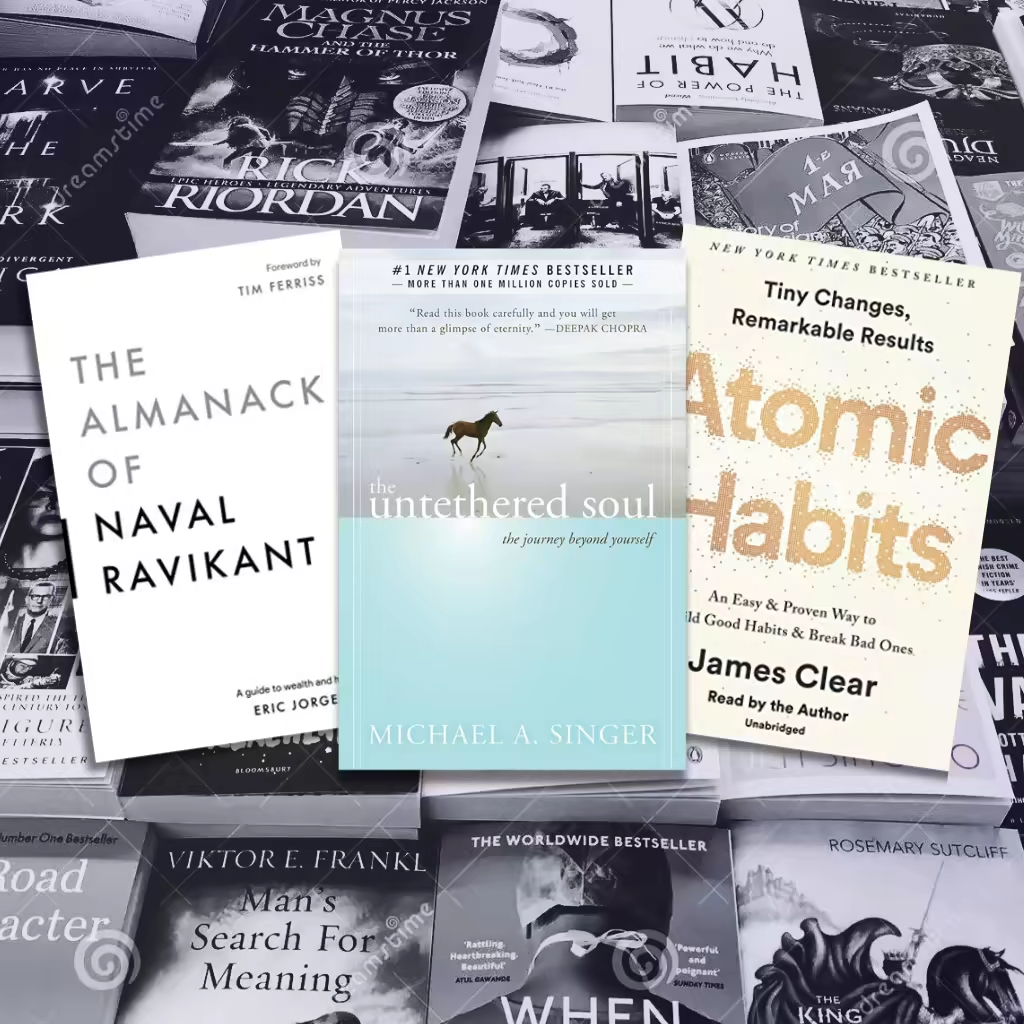
You might think that reading faster will save you time but the truth is, it doesn’t make any sense to take reading as a race competition. The brain is programmed to retain only substantially meaningful information, by skimming through words hastily your brain will dump the information away. Read slowly and reflect upon poignant points, your brain will process it thoroughly. As Naval Ravikant said “The smarter you get, the slower you read”.
One bonus tip is before you proceed to start from your earmarked page, try to reflect on the passages you read the last, this is important because you’ll test how much information your brain retains and will actively recall the lost information by connecting the dots.
Highlight and take notes
I know that many of you have high regards towards the practice of collecting books, and part of the reason why so many book readers refuse to highlight and markup their pages is to “conserve” the beautiful appearance of their collection. Highlighting and writing notes is useful because it allows you to quickly reread and ingest the most valuable points.
You should quit treating books like artifacts, yes they might mean so much to you but here is a tip on how you can fix this minor setback. When you’re purchasing a new book, try to order the used version (Make sure that it is clean), and while reading it take notes and highlight good points. If the book turns out to be packed with useful information and you decide to add it to your collection then purchase a newer version.
Read your worthwhile books twice
So you’ve read a book, and felt a sense of excitement because the book turned out to be valuable. The sad news is you have to read it twice because if your brain isn’t exposed to the same information frequently, this book’s information will be lost. The brain has a finite storage capacity, consequently it actively processes information to get rid of what it thinks you don’t need.
By applying the second practice I mentioned above, you’ll have an easy way to reread your book. The way I do it is I slowly flip through pages until I get to the notes I’ve labeled, then I reflect upon these ideas, by pondering them and searching on the internet what other people have said about this.
Write brief summaries
Every time you finish a chapter or an important section, stop and write a 2-3 sentence summary explaining concisely what you’ve learned in this chapter.
And then upon finishing the book, compile all your summaries and challenge yourself to explain the whole book in five sentences maximum. To do this, I often ask myself these following questions:
- What this book is about (Field or discipline)?
- What are the main ideas or the core message the author(s) is trying to communicate?
- What are the most implementable ideas?
- How would I describe this book to a friend?
Build a knowledge tree
A good way to visualize a book is like a knowledge tree starting from fundamental basic concepts forming a trunk and then splitting up into many branches of different details. Your learning becomes easier and more entertaining when you categorize each concept and illustrate it like a tree.
Many highly effective persons like Musk use this method to learn topics faster, they deconstruct the fundamental principles, grasp the core concepts and then you swiftly try to understand the descendant notions and categorize them each to its fitting place. Using these connections lets you remember new information quickly by hanging it on ideas already understood.
Talk to others about ideas you saw in your books
Humans are social species, they need to connect with other people. And our brain is more alert during the conversations we have with others, so why not share your interesting points with your friends and discuss it. Asides from firmly retaining the information, this practice comes with two extra underlying benefits. First you’ll have a chance to explain an idea to them, this challenge will make you connect information so that you have it easily explained to them. The second is that your friends might have some insights that you don’t know about in the topic you are discussing.
Seek other resources
Don’t enclose yourself with one only perspective, highly effective people try to understand the workings of the world using multiple lenses. Keeping yourself only to the author’s perspective, or unknowingly not paying attention to your cognitive biases will give you a wrong sight of the topic you’re trying to learn.
Navigate other resources such as articles or other books of the same topic and try to discern the truth from the wrong, even if it means changing your beliefs or opinions. This helps remove staining filters and see the world in a brighter and fuller picture.
Implement as fast as possible
Reading without implementation is academic entertainment. Unless you’re into novels and fiction books (which is not the topic of this post), if you don’t apply principles you read then you’re just wasting your time by indulging this academic pleasure.
Everytime you read a new useful book, try to implement its core message in your life and see if it’s working for you. That’s the magic of reading; it transforms into a life-changing habit.
A bonus benefit of implementation is your brain will notice a new behavior that is actually working and therefore it will stick in your mind.
Quit cheesy books
Sometimes you might be reading a book that has no practical ideas or valuable wisdom with no benefits to your life whatsoever. Don’t buy into every author’s branding, additionally it doesn’t take too much to figure out if the book is worth your time or not. You don’t have to read each book page-by-page, you can start by scanning the table of content, flipping through the chapters or titles, and noticing the heading of book sections.
Stop attaching strings to a book and understand that it is okay to quit a book quickly with no shame or guilt.
Design a proper reading schedule and environment
Reading is an active process, it needs flow. Experts say that surroundings have a far greater impact on productivity than the average human thinks. Pick a cozy sitting and put your phone away before you dive into a book. Setting the right environment is so important, and this applies to everything, not just reading.
Furthermore, block a schedule specifically for reading, my best time to read is during a power nap and right right before bed.
In conclusion, knowledge is a compounded intellectual asset. As James Clear says “Learning one new idea won’t make you a genius, but a commitment to lifelong learning can be transformative”, so building wisdom takes time. Follow these practices and be consistent and you’ll watch how much smarter your brain might become. It is the closeness we have with these worthy treasures that we often take for granted.