
You want to embark on a journey through the realms of thought-provoking science fiction, where the boundaries of reality are stretched and philosophical inquiries abound. Today, we’re delving into a unique intersection of science fiction and philosophy. These novels possess a distinct philosophical bent, offering readers an opportunity to explore profound ideas through the lens of captivating storytelling. As someone who’s passionate of both philosophy and literature, I’m fascinated by the potential of fiction to serve as a gateway to philosophical contemplation.
In this article, we delve into a selection of science fiction novels that not only entertain but also challenge our understanding of existence, consciousness, and the universe itself. Join me as we uncover some of the most compelling works of philosophical science fiction. While this list of philosophical fiction books may not be exhaustive, it represents a collection of standout novels that are sure to ignite your curiosity and expand your mind. So, let’s dive right in.
Brave New World
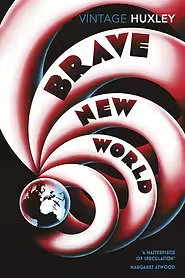
Brave New World is often overshadowed by Orwell’s 1984, yet I find it to be a highly underappreciated and relevant work. Huxley’s portrayal of a dystopian society is particularly prescient, offering insights into modern-day realities that surpass even the predictions of 1984. The novel, written during the emergence of the Industrial Revolution and Henry Ford’s assembly lines, revolves around a society where folks worship Ford like a god. This could be reflected today in the obsessed admiration of cult-like personalities like Elon or Trump.
Huxley explores existential themes in Brave New World, questioning happiness and humanity’s essence. Characters, masking contentment, evoke deeper reflection. The novel’s power lies in its poignant portrayal of the human experience amid technological advancements.
Candide
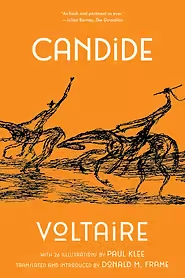
Let’s journey back to the 18th century with Voltaire’s Candide, a literary escapade that resonates with my earlier suggestion, The Stranger. Both Camus and Voltaire dissect religion, questioning the orchestrated nature of existence. Voltaire employs the character Candide to illustrate the folly of blind optimism. Candide, a happy-go-lucky individual, faces constant adversity – from the apparent death of his true love to the loss of his beloved professor. Despite the setbacks, Candide experiences a loop of misfortune followed by unforeseen good luck.
His recurrent cycle propels him between despair and the conviction that the world operates with a purpose. As the story concludes, Voltaire’s message rings loud and clear: in a world of chaos and unpredictability, we must “cultivate our own garden.” While acknowledging the certainty of challenges, Voltaire dismisses the notion that suffering serves a predetermined purpose.
Crime and Punishement

Crime and Punishment by Dostoevsky is a novel from 1866 that stands as one of the all-time greats. Dostoevsky, a master of philosophical novels, deserves a spot in any list of literary greats. Serialized in 1866, the novel unfolds the tale of Rodion Raskolnikov, financially strapped law student in Saint Petersburg compelled to drastic measures by dire circumstances. Raskolnikov’s family’s moral innocence contrasts sharply with the surrounding depravity, weaving a complex web of fates. This gives a vivid depiction to the grim setting of the novel.
In following the familiar story arc of a promising youth succumbing to urban perils, This book’s richness lies in its profound exploration of morality. Raskolnikov’s rationalizations, tinged with egoism and utilitarianism, echo the intellectual currents of Dostoyevsky’s era. The novel plunges into the repercussions of prioritizing intellectual prowess over moral principles, underscoring the dehumanizing effects.
Notes from Underground
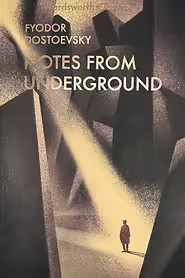
Notes from Underground seamlessly embraces existentialism, thrusting readers into the mind of the underground man, marked by hyper-consciousness and relentless self-scrutiny. This individual grapples with indecision, yearning for a specific reason behind his internal conflicts. Fantasizing the idea of laziness as a potential yet socially recognized cause for his struggles. Amidst the existentialist influences, individuals are empowered to carve their identity. Yet, Dostoyevsky’s underground man grapples with the vast possibilities, leading to alienation.
The story extends beyond existential musings, critiquing rationalism and challenging the utopian notion of a society devoid of emotional influence. He contends that irrational, emotion-driven choices are inherent in humanity. We resonate with this, recalling moments in our lives where we irrationally endured suffering. The exploration in Dostoyevsky’s account makes this an engaging, thought-provoking journey.
The Stranger
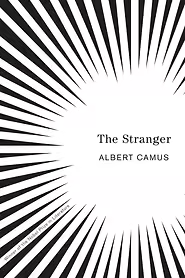
Albert Camus’ The Stranger swiftly unfolds with the demise of the protagonist’s (Meursault) mother, casting him as emotionally detached and isolated. Camus, diverging from existentialism with his philosophy of absurdism, contends that life lacks inherent meaning. According to this perspective, life unfolds in randomness, chaos, and illogical twists, void of predetermined order. Within Camus’s broader body of work, The Stranger seamlessly aligns with his exploration of absurdism, inviting readers to ponder life’s unpredictable and purposeless nature.
A pivotal incident in the novel illustrates Meursault’s act and his absence of remorse, only annoyance at himself. This relatable facet mirrors the human inclination to make irrational choices, displaying irritation rather than immediate guilt. The book prompts reflection on the inherent absurdity of life, acknowledging that not everything is within our control, and not every event carries a discernible purpose.
The Island

At number six on our list is The Island by Aldous Huxley. Published in 1963, this novel marks Huxley’s final literary work. The story unfolds in the utopian society of Pala, revolving around Will Farnaby, an English journalist. Farnaby visits Pala for research purposes and uncovers a unique utopia where the residents have ingeniously merged the finest aspects of Western and Eastern cultures. Consequently, they have fashioned a paradise on Earth. Farnaby becomes enamored with Pala, its inhabitants, and their way of life.
However, the idyllic island faces a looming threat. A new leader is set to emerge—a child raised and educated outside of Pala. Considered by many as Huxley’s masterpiece, The Island captivates readers by vividly portraying the utopian setting. Huxley skillfully weaves philosophical themes throughout the story, exploring mystical experiences, democracy, corruption, capitalism and consumerism.
The Handmaid’s Tale
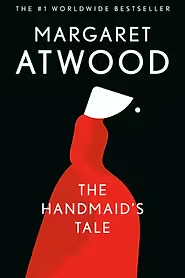
In Margaret Atwood’s near-future novel, The Handmaid’s Tale, a Christian fundamentalist regime known as the Republic of Gilead orchestrates a takeover, morphing the United States into a theocratic stronghold where its draconian measures are targeted particularly towards women. Published in 1985 during a period of conservative backlash against the second-wave feminist movement, the novel imagines a future where the conservative counter-movement not only erases women’s progress towards equality but also subjugates them entirely to male
dominance. While set in the future, Atwood adheres to not introduce any event or practice not already present in human history, this ties Gilead’s oppressive regime to the rigid rules of Puritan society in colonial Massachusetts—imposing moral codes, modest clothing, banishing dissenters, and regulating every facet of life. Atwood weaves a chilling tale, skillfully merging speculative fiction with philosophical echoes.
Brave New World
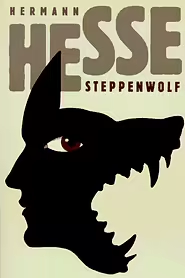
Personally, Hesse tops my list of favorite authors, his body of work is so captivating. While I could exclusively laud Hesse’s creations, Steppenwolf stands out—the cult favorite published in 1927. The story revolves around Harry Haller, a middle-aged man drowning in despair. Alienated from society he is paradoxically a part of; the middle-class bourgeoisie. He envisions himself as a lone wolf of the steppes. Amid battling depression and contemplating suicide, Harry’s journey unfolds through captivating encounters, romances, and bewildering experiences.
Hesse’s writing in Steppenwolf is akin to poetry; It is dark, filled with sorrow, yet strangely beautiful. Exploring myriad themes—nihilism, pessimism, existentialism, personal identity, mysticism, and alternate realities—it’s a profoundly philosophical read. For those craving intellectual depth, Steppenwolf ranks among the finest literary treasures.
Metamorphosis
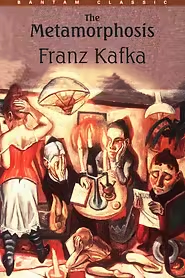
One of the darkest and most surreal authors to read is Franz Kafka, he emerged as a visionary far ahead of his contemporaries. Picking from Kafka’s trove proved daunting, but I narrowed it down to The Trial and The Metamorphosis. Ultimately, I opted with the latter. Within this book, a novella of profound brevity, unfolds a story of shadows, a daunting metamorphosis befalling Gregor Samsa. Waking to a grotesque transformation into a massive insect, Samsa grapples with the repercussions of his past life and the formidable challenges that ensue.
Profound and unsettling, this work invites introspection that lingers, a narrative so potent it sparks contemplation for weeks. The book itself is not overt and explicit in the message it conveys, which contributes to its greatness. Consequently, there are numerous interpretations and opinions about what this book is truly about. I strongly recommend reading it and forming your own interpretation.
Zen and the Art of Motorcycle Maintenance
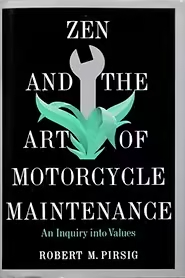
So now, let me tell you about one of this absolute gem, Zen and the Art of Motorcycle Maintenance. The format of the book is quite interesting—it’s an extended, dense personal essay about the author on a motorcycle trip across the country with his teenage son and a couple hitching along. The kicker? Between the road tales, he sprinkles in these things he calls Chautauquas—practical philosophy snippets and how those abstract concepts apply to everyday living. He yanks out the whole Western zeitgeist, dirt and all, inspects the roots, and pops it back in.
What I love about this book is that the philosophy you’re delving in with this book is something you can cozy up with, despite mentioning figures like Kant, Aristotle, Socrates and many others. He yanks out the whole western zeitgeist, inspects the roots, and pops it back in. Mind-blowing. Top perk? This book doesn’t just tango with deep thoughts; it leaves you a bit wiser each time you flip its pages.
Frankenstein

And finally, this is a book that, if it hadn’t existed, I don’t think any science fiction would exist, and that is Frankenstein by Mary Shelley. The book traces the story of Dr. Frankenstein’s, driven by an audacious pursuit of pushing scientific boundaries, endeavors to bestow and sustain life. He assembles a creature from dead matter and electrifies it into a conscious being. Horror ensues, prompting the doctor’s flight and a chilling chase with his creation. Yet, Shelley’s novel isn’t merely a monster tale. It delves into the essence of personhood.
This idea has come up in several of the other books that we’ve discussed. The creature, ironically, embodies humanity more than its creator. This is a wretch who reads Paradise Lost and is looking to love someone, but all he finds is a world that shuns him. The text explores the fine line between creation and destruction, embodied in Dr. Frankenstein’s hamartia — a god complex leading to ethical consequences.
Fahrenheit 451
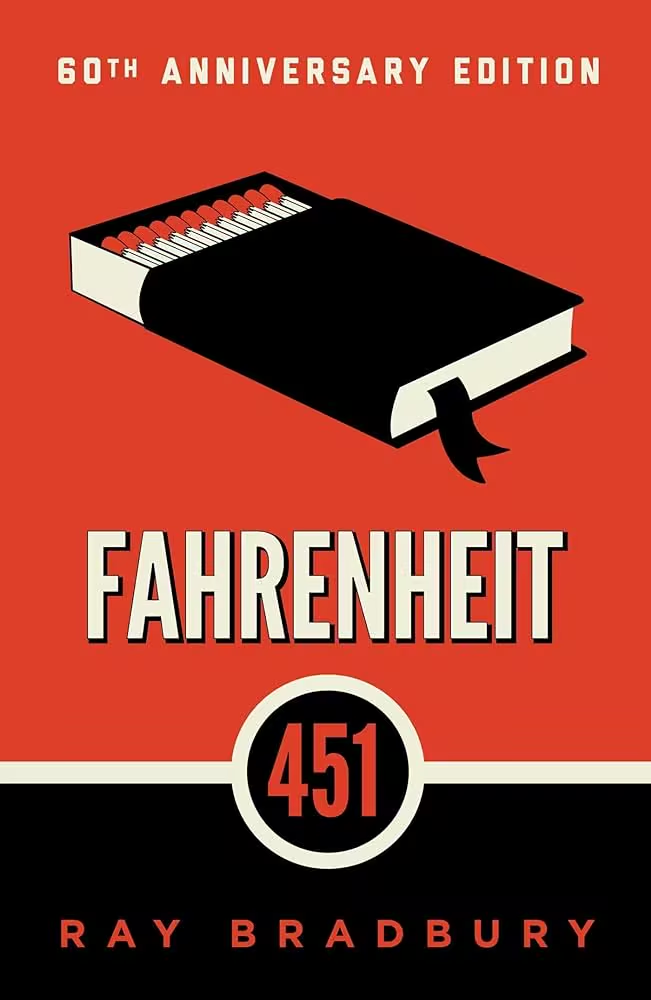
Fahrenheit 451 by Ray Bradbury is a spine-chilling tale of a world where books are banned and firemen burn any that are found. This classic novel of science fiction, published in 1953, delves into the sinister depths of censorship, conformity, and the chilling consequences of suppressing dissenting ideas. The protagonist, Guy Montag, is a fireman who begins to question the government’s actions and his own beliefs. Along the way, he meets a group of rebels who memorize books to preserve knowledge and culture, and the story takes off from there.
The government in this dystopian setting, actively snuffs out any form of free thought and Bradbury masterfully uses this story to comment on the oppressive nature of censorship, and the manipulation of society that follows. The importance of knowledge and free thought are also explored, with those who value them portrayed as heroic figures, while those who conform, complicit in their own enslavement.
Solaris

Many people consider Lem’s work to be at the pinnacle of philosophical science fiction, with Solaris as a standout masterpiece. It goes beyond exploring technological possibilities; instead, it’s a deep dive into the realms of existence, pondering what life might encompass and the cosmic mysteries awaiting us. In Solaris, the planet itself emerges as a central character, inviting us to question personhood and humanity. The narrative prompts us to reflect on the similarities we share with entities light-years away, urging us to seek common ground.
Themes of memory and identity further enrich the storyline,unraveling the enigma of what makes a person, how identity endures, and the very essence of personhood. For those entangled in the intricate threads of defining personhood and wrestling with the persistence of identity, Solaris IS a cosmic odyssey of thought, beckoning us to ponder the profound questions that echo across the universe.
Flowers for Algernon
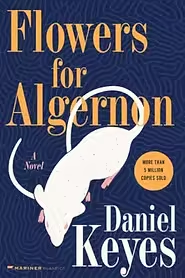
Human intelligence is one the greatest human gifts, yet the relentless pursuit of knowledge can sometimes lead to tragic consequences. Step into the extraordinary world of Flowers for Algernon, a science fiction written in 1959 by Daniel Keyes. Picture Charlie, a man grappling with intellectual challenges, transforms into a genius after a groundbreaking surgery, outshining even the medical minds. The narrative delves deep into self-perception and the evolving comprehension of reality as Charlie’s intellect expands—a riveting journey laced with anguish.
The story in Flowers for Algernon mirrors the current cultural landscape, where conversations about neurodiversity and acceptance are gaining momentum. In the vein of ‘Of Mice and Men,’ the story’s tragic beauty resonates, prompting a crucial dialogue on societal judgment’s consequences. Its exploration of the human condition leaves an indelible mark on our understanding of crucial human compassion and empathy.
Sophie’s World
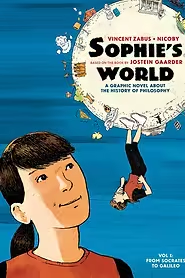
Now, when I refer to philosophical fiction, I mean literally a literary work of fiction centered around philosophy. Sophie’s World by Jostein Gaarder exemplifies this genre, serving as a captivating exploration of the history of Western philosophy. Picture Sophie Amundsen, a curious young soul bombarded with cryptic letters posing profound questions like “who are you?” These letters kick off her wild expedition into the world of philosophy. As her story progresses, she stumbles upon the sender, a peculiar philosopher named Albert Knox.
Under his tutelage, Sophie learns about major philosophers and their ideas, spanning from ancient Greeks like Socrates and Aristotle to more contemporary thinkers such as Kant and Nietzsche. Despite its academic subject matter, Sophie’s World remains a gripping tale that beckons even those uninitiated into philosophy, and is authentic to its literary form making it a true gem that you can’t put down.